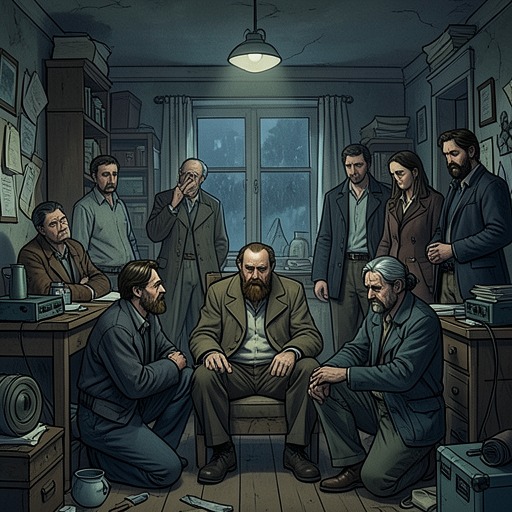
Fyodor Pavlovich and Smerdyakov’s presumed father–son relationship
The Brothers KaramazovFyodor Pavlovich and Smerdyakov’s presumed father–son relationship rests on a pointed contradiction: Fyodor Pavlovich denies responsibility for Smerdyakov’s birth, yet accepts the child into his household, permits a patronymic marking him as Fyodor’s son, and later entrusts him with service. The uncertain paternity does not make the connection incidental; it gives Smerdyakov a place inside the family while leaving the nature of his belonging unresolved.
An orphan taken into the household
Smerdyakov enters the relationship through the death of his mother, Lizaveta. After the baby is saved but Lizaveta dies at dawn, Grigory brings the child home and places him on Marfa’s lap. His appeal to her is at once compassionate and accusatory: the orphan, he says, is akin to everyone, and especially to them; he calls the baby both their “little lost one” and the child of “the devil’s son and a holy innocent.” The language joins an act of care to the unresolved story of the child’s parentage.
Marfa raises the infant, who is christened Pavel. People add Fyodorovitch, meaning son of Fyodor, to his name, and Fyodor Pavlovich does not object. Yet his tolerance of the patronymic does not amount to an admission: he continues vigorously to deny responsibility. The townspeople, by contrast, are pleased that he has adopted the foundling. Their approval frames the arrangement as a form of adoption even while the question of biological fatherhood remains publicly unsettled.
Naming and contested paternity
The naming sequence makes the ambiguity visible rather than resolving it. Pavel is given a patronymic associating him with Fyodor Pavlovich, while Fyodor Pavlovich later invents the surname Smerdyakov, derived from his mother’s nickname. The names thus preserve two different traces of origin: one points toward the man’s disputed paternity, the other toward the mother whose death made him an orphan.
Fyodor Pavlovich’s conduct sustains that double meaning. He lets the child be called Fyodorovitch and later supplies a surname, but still denies that he is responsible for Smerdyakov’s birth. The household arrangement gives Smerdyakov a recognized place without settling the question of kinship. The resulting bond is neither simply acknowledged fatherhood nor simple separation: it is a relationship in which social inclusion and verbal disavowal coexist.
From foundling to servant
As he grows up, Smerdyakov becomes Fyodor Pavlovich’s second servant. The narrative therefore places him inside the household but in a subordinate role, a practical closeness that does not erase the uncertainty surrounding his origins. The possible father is also the master; the possible son serves him. That imbalance makes the relationship legible through daily dependence as well as through contested naming.
The relationship also bears on Fyodor Pavlovich’s rivalry with Dmitri over Grushenka. Smerdyakov knows that Fyodor Pavlovich is besotted with her and observes that he is unlikely to provide Dmitri with money to pursue her while desiring her himself. He also knows that Fyodor Pavlovich has recently withdrawn three thousand roubles, changed them into hundred-rouble notes, placed them in a large envelope, sealed it with five seals, and tied it with red tape. This knowledge gives the servant a close view of his master’s private interests and preparations; in the immediate conflict, Smerdyakov presents it as information relevant to Dmitri’s hopes and to Fyodor Pavlovich’s own intentions.
Trust without acknowledgment
Despite Smerdyakov’s anger on one occasion, Fyodor Pavlovich has what the narration describes as absolute confidence in his honesty. The basis is a remembered incident: while drunk, Fyodor Pavlovich dropped three hundred-rouble notes in the muddy courtyard. He did not notice their loss until the next day, when he was about to search his pockets; the notes had already been placed on the table after Smerdyakov picked them up and brought them in the previous day.
Fyodor Pavlovich responds with uncommon praise, telling him, “Well, my lad, I’ve never met anyone like you,” and gives him ten roubles. He not only believes Smerdyakov honest but, for some reason, likes him. The episode sharpens the relationship’s central contrast: Fyodor Pavlovich refuses the paternal claim, yet displays confidence and personal regard toward the servant he may have fathered. His small reward recognizes Smerdyakov’s conduct, but it does not resolve the larger question of what he owes him as a son.
The meaning of an unresolved bond
The relationship is shaped less by a definitive declaration than by incompatible forms of recognition. The patronymic, Fyodor Pavlovich’s role in naming Smerdyakov, the townspeople’s pleasure at his adoption, and the child’s place in the household all make a connection socially visible. Fyodor Pavlovich’s vigorous denial keeps biological responsibility unconfirmed, while his trust in Smerdyakov gives their daily relationship a measure of intimacy that exceeds mere indifference.
That tension gives Smerdyakov’s position in the family its particular significance. He is close enough to serve in the household and to know its master’s private business, yet his possible status as a son is never secured by an acknowledgment of paternity. The bond therefore joins care and exclusion, familiarity and hierarchy: Fyodor Pavlovich accepts Smerdyakov’s presence and relies on his honesty, but leaves the fundamental question of fatherhood suspended.